Jericho
Never Kiss a Man in a Christmas JumperJericho is the home setting for Maggie O’Donnell’s family life, but its significance reaches beyond a fixed address. Through the park near her home and the rooms she prepares for Marco Cavelli, it becomes a measure of time passing: Maggie remembers childhood, young motherhood, and Ellen’s growth against a landscape that seems unchanged, while the house gathers the practical and emotional pressures of a new, temporary closeness. At Christmas, familiar surroundings offer shelter even as they sharpen Maggie’s fear of being left alone in them.
Setting and recurring landscape
The park is ten minutes from Maggie’s home in Jericho. From there, Oxford city centre and its dreaming spires appear through fog, distant and softly lit against the winter sky. The view is beautiful, but its apparent constancy is what gives it force: the city seems not to change, even as Maggie’s life has moved through successive versions of itself. The park is therefore more than a scenic pause in the narrative. It provides a stable point from which she can take stock of a life altered by time and family responsibilities.
The park’s playground also gives the setting a public, everyday character. Maggie looks across it while Ellen listens to music nearby, and the ordinary scene makes her melancholy. That sadness arises in part from the contrast between the place’s continuity and the changing people who return to it. Jericho is presented not through a broad account of its streets or history, but through Maggie’s repeated personal encounters with a familiar local landscape.
The park as a record of family time
Maggie’s memories of the park reach back to her own childhood, when her mother brought her there. She recalls herself later as a reckless teenager, drinking cider and spinning on the roundabout. These remembered stages are not separate from the present setting; they accumulate within it. The park that once belonged to her childhood and adolescence is also the place where she later spent long hours as a very young parent.
As a young mother, Maggie brought her baby daughter there in a pram, fed the ducks, and wondered what her friends were doing. She then watched Ellen pass from toddlerhood through childhood toward adulthood. The sequence makes motherhood feel both intimate and temporal: the same surroundings have held a child in a pram and, years later, an almost-adult daughter with a life increasingly her own. Maggie imagines those earlier versions of their lives as scenes that might replay, though imperfectly, like fragments of a dream. The park’s apparent permanence thus frames a history that cannot be recovered in full.
Home and temporary domestic change
The domestic setting associated with Jericho becomes especially important when Maggie agrees to care for Marco during his recovery. The arrangement is daunting, but it will keep her occupied. Leah helps prepare the house before leaving for Scotland with Rob and Luca: she adds Christmas decorations, stocks the fridge with Marco’s favourite beer, and gives Maggie a substantial farewell hug. These practical preparations turn the home into a place organized around Marco’s temporary needs, while also making the departure of the rest of the family tangible.
The rooms are rearranged to preserve some separation between care and private life. The main living room is equipped for Marco, with a television and DVDs, and a nurse is due to visit each morning to help with personal care. A second living room, normally occupied by Maggie’s fabric samples, patterns, and bridal-magazine cuttings, is cleared as a retreat for her. The arrangement gives Maggie a space of her own even as the house accommodates another adult. Marco’s broken leg also makes the upstairs inaccessible to him. Maggie notes that she has lived only with her father before, while Ellen has never lived with a man; the upstairs remains outside the new arrangement, a domestic boundary Maggie is relieved not to have to alter.
Christmas, departure, and the meaning of home
Snow coats the front garden, remaining pure and untouched. Its stillness contrasts with the former routine of Ellen playing outside and ambushing passing postmen. Now Ellen is at a pub saying goodbye to her boyfriend, Jacob, and drinking cider. The scene registers a change in the household without presenting it as a single dramatic break: the familiar garden is still there, but the daughter who once played in it is making her own plans beyond it.
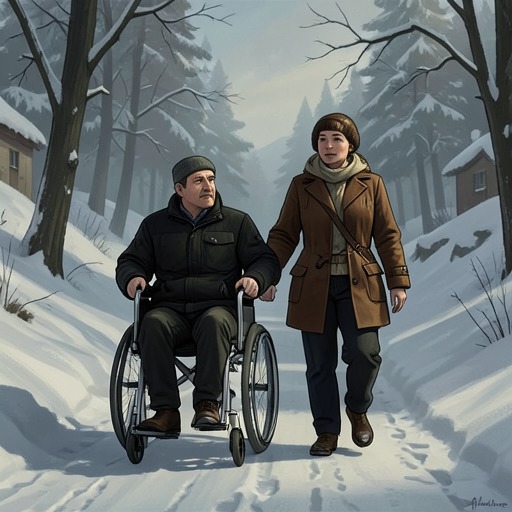
Maggie and Marco walk back to Jericho after she has made an unplanned confession. She tries to keep the conversation light, and Marco respects her wish not to discuss what she has revealed. His sensitivity makes the walk a moment of trust, but the cold and his dependence on crutches also keep his physical recovery present in the scene. When they reach a pub, Maggie considers whether he can manage without the wheelchair and jokes about finding them a seat. Jericho’s streets thus connect private vulnerability with ordinary public life; the relationship develops through the small negotiations of getting home and finding somewhere to rest.
Maggie’s decision to remain at home rather than go to Scotland with Marco is shaped by more than one concern. She wants to attend Isabel and Michael’s Christmas Eve wedding, but she is also unsettled by how close she and Marco have become and by the prospect that he will leave for Scotland and then Chicago. The story that she will go to Scotland has been accepted by her family, partly because Marco presents it convincingly and partly because that version is easier for them. Her actual intention to stay exposes the difference between the family’s expectation and her private understanding of what their temporary intimacy might cost.
After Ellen’s departure, Maggie anticipates the emptiness that will follow and sets herself tasks: return to work, prepare Isabel’s dress, and collect Marco. Later, amid the wedding party, the thought of going back to her empty home becomes especially painful. She imagines the signs of Ellen’s recent presence, Marco’s belongings soon to be gone, her father’s unoccupied flat, and the Christmas decorations awaiting her. Home holds several absences at once. Maggie recognizes that a life protected from complication and risk has become a half-life, and the contrast with the joy she sees in Isabel and Michael makes that recognition sharper.
Narrative significance
Jericho’s significance lies in the way familiar places gather different moments without stopping time. The park holds Maggie’s remembered childhood, adolescence, and young motherhood; the house accommodates a shifting family and Marco’s convalescence; the streets carry Maggie and Marco through an emerging intimacy. These settings are not simply comforting. Their familiarity can make change more visible, especially as Ellen grows up and Marco’s stay approaches its end.
The location consequently holds together two opposing possibilities. Jericho is where Maggie can remain, care for others, and retreat into routines she knows. It is also where the prospect of returning to an empty house forces her to confront what those routines have kept at a distance. Its quiet continuity does not resolve her fear of loss; instead, it gives that fear a recognizable landscape.